01
Start with your questions
Prices, timing, streets, property taxes: every West U question gets a direct answer grounded in current data, not a sales pitch.
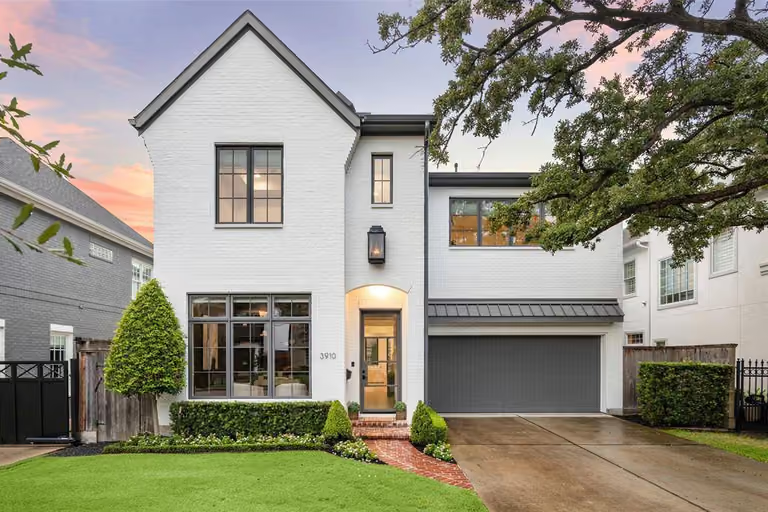
At home in West U.
Neighborhood answers, current market data, and a clear next step, whether you're buying in West U or thinking about selling. From Paige Martin, Real Broker, LLC.
New to the area? Start with the West U neighborhood guide.
By the numbers
West U market data as of September 2026.
These figures in context: see the full West U market update.
Questions & answers
One question, and only one: is a property in West U worth more to a family, or to a builder? Everything here (the replacement record, the zoning envelope, the tree ordinance and the permit sequence) exists to make that question answerable from public documents rather than from an opinion.
It is a narrow subject on purpose. A general neighbourhood guide answers where to live and what the area is like; this site answers what the land under a house is worth relative to the house standing on it, which is a different question with different evidence behind it. Every figure comes from the Census Bureau's permit record, the city's zoning ordinance, its tree ordinance, its published permitting process, or a market-statistics feed that recomputes overnight. Where no public record exists, the page says so instead of estimating. The whole argument, with the sources named against each claim, is set out in the West U guide.
The median sale price is $2,057,500, an average of $543 per square foot, with 203 sales in the trailing twelve months and about 4.1 months of supply. The median home went under contract after 32 days and closed at about 99.8 percent of asking. Figures as of September 2026.
Those figures cover West University Place together with the Southside area beside it, and they are recomputed overnight rather than typed in by hand, so the sentence you are reading and the band above it can never disagree. What they cannot do is price one property. A market median averages original houses and rebuilt ones, small sites and large ones, so it moves whenever the mix of what sold changes even if nothing about the market moved. The sales count behind the figures, the ten-year series and how much weight any of it can carry are on the market update.
Three of them. The city's zoning ordinance fixes minimum site dimensions, yards, open and pervious floors, height and framed area. Chapter 82 of the city code governs the trees. The city's own published permitting process sets out the review sequence and the order things have to happen in.
The first document is where the old-site and new-site distinction lives: a building site established with its present boundaries before 24 October 1987 may be as small as 5,000 square feet in the Single-Family District, where a later one must reach 8,250 square feet at 75 feet wide and 110 feet deep. The second is where the surprise lives: once a development permit is in play, every large tree on the site is protected, and a large tree starts at 19 inches of circumference. The third is where the time lives. All three are quoted, with the table or section behind every number, on the page about the buildable envelope.
It has two answers, and the larger one decides how the property should be sold. There is what the house is worth to somebody who wants to live in it, and what the site is worth to somebody who intends to replace it. A market median gives you neither.
Separating the two takes the facts specific to your address: the date your building site was established, its width, depth and area, what the existing house does with the framed area the ordinance allows, and what is standing on the site in the way of large trees. Those decide what a builder could build and therefore what a builder can pay, and none of them are visible in a market statistic. Send the address, and the plat and any tree survey you already hold, and ask for a home valuation that prices both sides of the question.
Ask which of the two values they are pricing, and ask to see the document behind each figure they quote. An agent working here should be able to say whether a building site is an old or a new one, what the envelope allows on it, and what the tree survey will do to a builder's timeline.
That is a testable standard rather than a matter of chemistry. West University Place has its own zoning ordinance, its own tree ordinance and its own permitting sequence, and an agent whose experience is in the City of Houston or unincorporated Harris County is working to a different rule book. The difference shows up as a mispriced listing rather than as a refusal. The agent-selection page answers the question directly and shows the record behind the answer.
How this site works for you
01
Prices, timing, streets, property taxes: every West U question gets a direct answer grounded in current data, not a sales pitch.
02
Neighborhood-level numbers, refreshed as the market moves, so a decision to buy or sell in West U rests on data rather than headlines.
03
Paige Martin works in West U specifically: one neighborhood, followed closely, with the details that only come from being local.
Your next step
Ask for a valuation grounded in current West U sales, or put time on Paige Martin's calendar to talk through a purchase or a sale.